A video production brief should give a production company enough context to recommend an appropriate creative approach and quote a defined scope. Before requesting a quote, include the business problem, objective, audience, one primary message, available proof, intended placements, required deliverables, timeline, approval process, budget context, brand and legal requirements, accessibility needs, and success criteria.
The brief does not need to prescribe cameras, a shot list, or a finished concept. Its job is to explain why the video needs to exist, what the viewer needs from it, where the finished assets will work, and which constraints are already known. That information allows production partners to price the same job instead of making different assumptions.
Define the business job before the video format
Many early enquiries begin with a format: a two-minute company video, a series of social clips, or something similar to a reference the team likes. Those details can be useful, but they do not tell a production company what the asset must accomplish for the business.
Start with the point in the buying journey where communication is breaking down. Perhaps referred prospects reach a service page but still do not understand the process. A sales team may repeat the same explanation on every call. A launch may need customer proof, or a proposal may need a credible introduction to the people behind the service.
Once that job is clear, the production partner can recommend whether the project needs a founder video, service explainer, customer story, campaign asset, FAQ library, or another approach. YWD’s business video production overview shows how different formats support trust, clarity, proof, and ongoing communication. The brief should establish the business need; creative development should determine how best to answer it.
The terms video production brief, video project brief, and creative brief for video production are often used for overlapping documents. Before a quote, the useful distinction is practical: the business supplies the objective, audience, message, evidence, destinations, requirements, and constraints. The production partner then develops the treatment, script, storyboard, shot plan, and technical approach required by the approved scope.
Copyable video production brief template
Copy the template below into a document and replace the prompts with your project information. Short, specific answers are more useful than polished marketing language. If a decision has not been made, write “open to recommendation” and explain the constraint that the recommendation must respect.
VIDEO PRODUCTION BRIEF

Project name:
Company:
Prepared by:
Date:
Primary contact:

1. BUSINESS PROBLEM AND OBJECTIVE
What business situation has created the need for this project?
Where are customers, prospects, employees, or partners currently missing
information, confidence, or proof?
What should this video help the business communicate or support?
What should the viewer do next?
What is outside the scope of this project?

2. TARGET AUDIENCE
Who is the primary viewer?
Where are they in the buying or decision process?
What do they already know?
What question, concern, or hesitation should the video address?
Are there secondary audiences? If so, how important are they?
Are there language or accessibility needs?

3. SINGLE PRIMARY MESSAGE
Complete this sentence:
After watching, [audience] should understand that [primary message],
because [most credible supporting proof].

What action should follow that understanding?
Which secondary points may support the message?
Which claims or topics must not appear?

4. PROOF, PEOPLE, AND MATERIAL AVAILABLE
Who can speak with authority on camera?
Which customers may participate, and is permission confirmed?
Which process, location, product, service, or team activity can be filmed?
What evidence is available: approved facts, demonstrations, case material,
documents, screenshots, existing footage, or customer proof?
Which brand files, photographs, graphics, or previous videos already exist?
What still needs permission, verification, or creation?

5. INTENDED PLACEMENTS AND BUYER TOUCHPOINTS
What is the primary placement?
Where else will the material be used?
What will the viewer have seen immediately before the video?
What should be available immediately after it?
Will the video be used on a website, landing page, sales follow-up,
proposal, email, presentation, event, organic social, paid media,
recruitment, onboarding, or training?
How long should the assets remain useful?

6. REQUIRED DELIVERABLES AND VERSIONS
List each business asset required, not only “one video.”
For each asset, note its placement, orientation, caption needs,
language, approximate duration if known, and call to action.
Do you need cutdowns, alternate openings or endings, clean versions,
captioned versions, subtitle files, transcripts, thumbnails, still frames,
or source footage?
Which items are required, and which are optional?

7. TIMELINE AND APPROVAL PROCESS
When must the finished assets be in use, and why?
Are there launch, event, campaign, travel, or staff-availability dates?
Who supplies information and materials?
Who reviews the concept, script, rough cut, and final version?
Who consolidates feedback?
Who has final approval?
Does legal, compliance, a customer, or another external party need to review?

8. BUDGET CONTEXT OR SCOPE EXPECTATIONS
Is there an approved range, planning range, or maximum?
If the budget is not set, what scope is expected?
What is the must-have outcome?
What can be reduced, postponed, or treated as an option?
Are the number of locations, filming days, participants, or versions limited?
Would phased options be useful?

9. BRAND, LEGAL, AND ACCESSIBILITY REQUIREMENTS
Link the current brand guide and approved assets.
List required terminology, disclaimers, claims, or prohibited language.
Identify permissions or releases needed for people, customers, locations,
products, music, stock material, or existing footage.
State caption, transcript, audio-description, language, or other
accessibility requirements.
Note any security, privacy, regulatory, or confidentiality constraints.

10. SUCCESS CRITERIA
What would indicate that the asset is doing its intended communication job?
Which signals can be observed or measured at the intended placement?
Who will review performance, and when?
Which factors outside the video may affect the result?
Avoid guaranteed sales or ROI targets; define useful evidence instead.

REFERENCES
Link examples and explain exactly what is relevant in each one:
message, interview style, pace, visual approach, proof, structure, or finish.
Also note anything the project should avoid.

KNOWN UNKNOWNS
List decisions you want the production partner to recommend.
How each section changes the quote and production plan
1. Business problem and objective
The objective should describe the communication job, not simply the existence of a finished video. “Create a company video” is a deliverable. “Help referred prospects understand our assessment process before they request a consultation” gives the production team a business reason, a viewer situation, and a likely next action.
This distinction affects the proposed format, interview questions, script development, call to action, and the amount of strategy required before filming. It also reveals when production may be premature. If the offer, audience, or next step is still unresolved, the useful first engagement may be diagnosis and message development rather than a firm filming scope.
2. Target audience
A useful audience description goes beyond industry and demographics. Explain what the viewer already knows, how they arrived at the video, what decision they are considering, and which concern is stopping them from moving forward. A referred buyer evaluating a high-value service needs different context from a person encountering the company for the first time in a social feed.
The audience influences the speaker, examples, vocabulary, pace, proof, and placement. If several audiences matter, identify one primary audience and state whether secondary versions are needed. Otherwise, one video may be asked to introduce the company, explain the service, reassure current customers, and recruit staff at the same time.
3. Single primary message
Choose the one idea the viewer should retain. A practical structure is: “After watching, this audience should understand X, because the video will show Y, and the appropriate next action is Z.”
The primary message does not prevent supporting points. It gives them a hierarchy. During scripting and editing, the team can keep material that strengthens the main idea and remove material that competes with it. That clarity also helps reviewers assess the work against an agreed communication job instead of adding new messages late in the edit.
4. Proof, people, and material available
List what the production can genuinely show. That may include a founder’s judgement, an expert explanation, a customer’s specific experience, a working process, a real location, product use, approved results, documents, screenshots, or existing footage. Visual references communicate taste; they do not replace evidence.
Availability changes the concept and the quote. A confirmed customer interview has different scheduling and permission requirements from a possible customer who has not been approached. Existing footage may reduce filming or may need technical review before it can be included. Knowing which people, locations, and materials are real allows the producer to plan interviews, B-roll, permissions, travel, and new asset creation accurately.
5. Intended placements and buyer touchpoints
Name the primary placement before listing channels. “Website” is too broad: a homepage introduction, a service-page explanation, a paid landing page, and a private proposal all meet viewers with different levels of context. Describe what the viewer has seen before the video and what action or information follows it.
Placement affects the opening, message density, call to action, aspect ratio, captions, and useful lifespan. It also reveals opportunities to plan a filming session for several defined touchpoints rather than treating every additional version as an afterthought. The goal is not to create the maximum number of files. It is to deliver the versions the business has a credible plan to use.
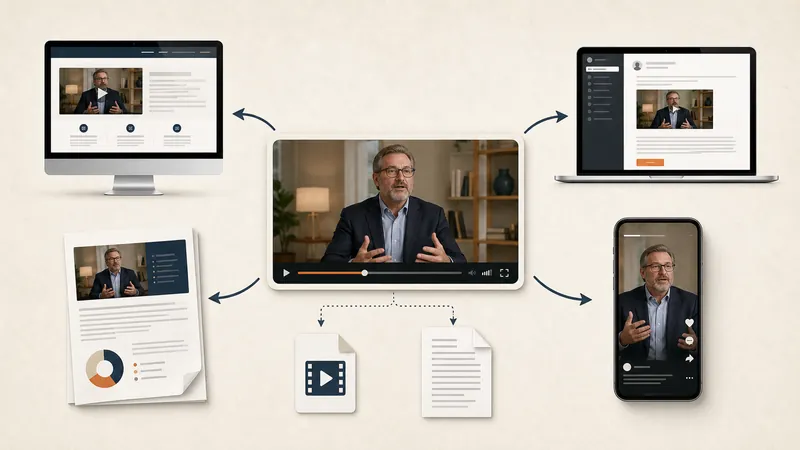
6. Required deliverables and versions
Write the deliverable list as business outputs. For example: one main service-page video, three short answers for sales follow-up, vertical versions for LinkedIn and Instagram, captioned masters, clean masters, a transcript, and a thumbnail. Ask the production partner to confirm the appropriate technical specifications.
Different orientations, languages, openings, calls to action, caption treatments, and review paths add real work. A cutdown is not automatically included because the main edit exists. When every quote uses the same deliverable map, the business can compare what each partner is actually proposing instead of comparing totals built on different assumptions.
7. Timeline and approval process
Give the date when the assets must be in use and explain what drives it. A launch, event, website release, participant schedule, or legal review may create intermediate deadlines that matter more than the final export date.
Name the people responsible for materials, reviews, consolidated feedback, and final approval. If several stakeholders send separate notes, the production team cannot know which direction has authority. A clear approval route helps the quote define milestones, review rounds, and schedule buffers, while allowing the producer to flag a timeline that would require a smaller scope or a different approach.
8. Budget context or scope expectations
A budget range helps a production company recommend an approach at the appropriate level. It does not need to dictate how every dollar is allocated. If there is no approved range, describe the expected footprint and the priority order: one location or several, one speaker or a group, a single core asset or a library, existing material or a new shoot, must-have versions and optional versions.
This context makes alternatives more useful. A producer can separate the essential communication job from enhancements, suggest phased delivery, or explain what must change to meet a ceiling. Without a range or scope boundary, one company may quote a focused interview-led project while another assumes a developed campaign production. Both numbers may be reasonable, but they are not answers to the same request.
9. Brand, legal, and accessibility requirements
Provide current brand files and identify the rules that affect content, not only appearance. Include approved terminology, substantiated claims, disclaimers, customer or location permissions, confidentiality limits, music or footage restrictions, and any review required by legal or compliance teams.
State accessibility and language requirements before the deliverables are scoped. Captions, subtitle files, transcripts, audio description, translated versions, and alternate on-screen text may affect writing, design, review, and export work. Early visibility lets the production team include these needs in the plan instead of treating them as a late revision.
10. Success criteria
Success criteria should match the communication job and intended placement. Depending on the project, useful signals might include whether the asset is published in every planned location, whether the sales team uses it in follow-up, whether viewers reach the intended next step, whether tracked engagement supports the chosen placement, or whether recurring buyer questions change after the video is introduced.
These are evaluation signals, not promises that production will generate a particular return. The brief should also acknowledge outside factors such as page traffic, media spend, offer quality, follow-up, seasonality, and measurement setup. A responsible production scope can define the asset, intended function, and measurement plan; it cannot guarantee ROI.
Hypothetical example: a completed brief in compact form
The example below is fictional. It is not a YWD client, project, result, or testimonial.
| Brief section | Hypothetical answer |
|---|---|
| Business problem and objective | A B2B operations consultancy is launching a manager-training service. Referred prospects understand the topic but do not know what participation involves. The video should prepare suitable prospects for a discovery call and direct them to the service enquiry form. |
| Target audience | Operations leaders at established companies who are comparing training options. They know the consultancy by referral but are concerned about generic material and disruption to their teams. |
| Primary message | The programme applies practical management tools to the client’s operating context through guided work, rather than relying on a standard lecture. |
| Proof, people, and material | The lead consultant and programme facilitator are available. The workshop location, sample exercises, and anonymized planning materials can be filmed. Customer participation is not assumed until permission is confirmed. |
| Placements | Primary: the service page. Secondary: proposal follow-up and direct sales email. Selected short answers may be used on LinkedIn. |
| Deliverables | One main service explainer, three short FAQ videos, horizontal and vertical versions where needed, captioned and clean masters, a transcript, and one thumbnail for the main asset. |
| Timeline and approvals | Assets must be live before enrolment opens. The founder and sales lead review content; the marketing manager consolidates notes and gives final approval. Claims are checked before the script is approved. |
| Budget or scope | One location and no more than two on-camera speakers. The main explainer and service-page use are essential; social versions are priced as a separate option if necessary. |
| Brand, legal, and accessibility | Use the current brand guide and approved programme terminology. Do not show confidential workshop information. Captions and a transcript are required. |
| Success criteria | The assets are live in the planned touchpoints, the sales team uses the explainer in follow-up, the enquiry action is tracked, and the team reviews prospect questions after the first enrolment cycle. No sales or ROI outcome is guaranteed. |
Use the brief to compare production quotes
A production quote is easier to evaluate when every company is responding to the same communication job and deliverable map. Check whether each proposal includes the same level of message development, pre-production, filming, editing, versions, accessibility work, review rounds, licensing, travel, and delivery support. Also note what the client is expected to provide.
If one proposal includes concept development, two filming locations, several versions, and a structured review process while another assumes a single finished edit from client-supplied direction, the totals are not directly comparable. The difference may be scope rather than price. Ask each partner to state assumptions, options, and exclusions in plain language.

Creative references deserve the same discipline. Link examples, then explain whether you are responding to the message, interview style, pacing, proof, structure, or finish. “Make it like this” can lead different teams to price entirely different elements of the reference. A written explanation keeps the reference useful without turning it into an accidental specification.
You can also review a production company’s portfolio to see the range of formats it has delivered, but the brief should still define the problem and intended use of your own project. Style alone does not establish scope.
The brief is a starting point, not the finished creative plan
A strong brief should create better questions. After receiving it, a production partner may challenge the assumed format, narrow the audience, propose different versions, or identify evidence that would make the message more credible. The next document may be a treatment, message outline, script, production plan, or formal scope.
That collaboration is useful. The business owns the context, constraints, approvals, and intended outcome. The production team should translate those inputs into a practical creative and production recommendation.
If your objective, audience, message, and placements are already clear, complete the YWD project brief so the team can assess the right production approach and scope. If you know video may help but are not sure which format should come first, use the YWD video diagnostic before requesting a quote.
Published on July 23, 2026 by YesWellDone Team
Updated on August 21, 2026


